1. What the research found
The best studies on this come from a group of Norwegian researchers. They took well-trained cyclists, kept their normal bike training, and added two gym sessions a week for one group only. After about three months:
- The gym group were faster over 40 minutes. The riders who only cycled showed no clear improvement.
- They were stronger at the end of long rides. After three hours of riding, the gym group could still push about 30 W more in a 5-minute all-out effort (from 371 W to 400 W on average). The bike-only group didn’t improve at all.
- It works for women too. A later study in female cyclists found the same kind of improvement.
A separate study gave cyclists just one exercise, heavy half squats, three times a week for eight weeks. They became about 5% more efficient on the bike, meaning they used less energy at the same power, and they lasted noticeably longer at a hard, steady effort.
2. Why it works
Strength training doesn’t make your engine bigger. In these studies the gym didn’t raise VO₂max any more than riding alone did. What changed is how well the riders used their engine:
You waste less energy. Stronger legs produce the same power at a lower cost. Over a three-hour ride, small savings add up.
You fade less. This is the part I like most for amateur riders. The biggest difference showed up at the end of a long ride, exactly when sportives and races are decided. Lower heart rate and less fatigue late in the ride is what we call durability.
It lifts the efforts that matter. A hard 40-minute effort sits close to your Critical Power. Improving it is exactly what we want from winter training. The gym groups also gained sprint power, which matters if your racing is decided in short, punchy efforts (my sprint guide covers the bike side).
3. Will it make me heavier?
This is the most common worry, especially from climbers. In these studies, the riders’ thigh muscles grew but their body weight didn’t change. Done alongside normal bike training, that’s what usually happens. If your weight creeps up in winter, look at food and total training before blaming the gym.
4. A bonus: your bones
Cycling is brilliant for your heart but does very little for your bones, because the bike carries your weight. A large review found that road cyclists often have lower bone density than you’d expect for such fit people. Strength work and some impact (a bit of running, jumping or hiking) are a sensible addition, especially for masters riders. If you already know you have a bone-density issue, check with your doctor first.
5. How I fit strength into the winter
Winter is the most important time of the year to build the foundations, and strength is part of that. For my athletes it works on two fronts.
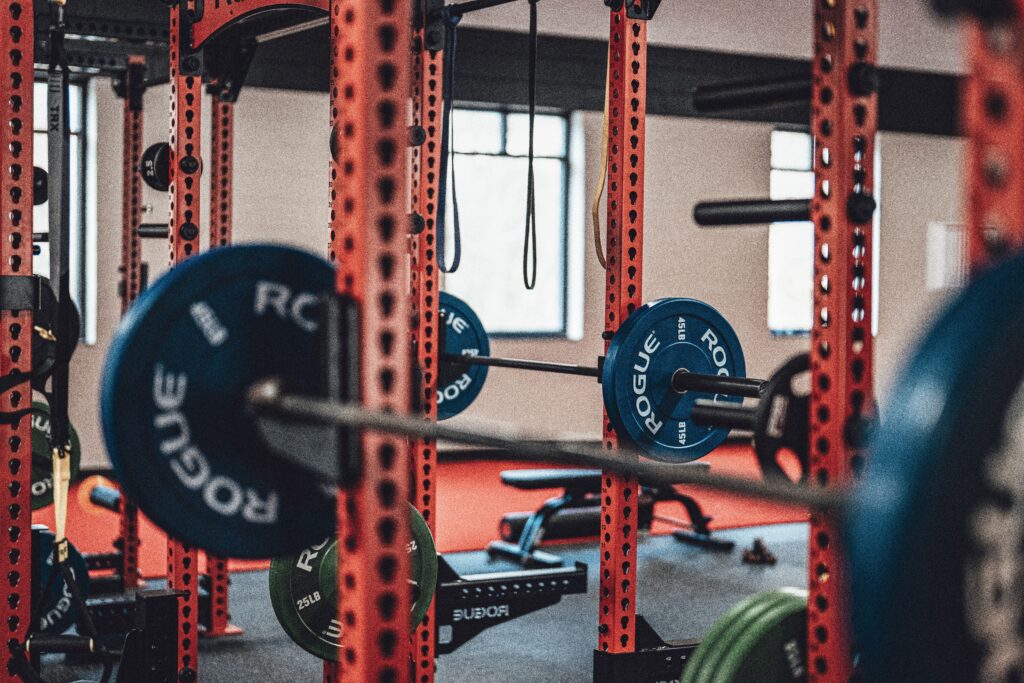
In the gym. Strength work is planned across the year. After the off-season transition, riders start with one lap of the winter circuit in the first month and build to two laps in months two and three. When the season starts, it drops back to one lap of a shorter in-season circuit. It usually goes on an easy day, often after a recovery ride, so it never gets in the way of the key bike sessions.
On the bike. I come from the Italian school of strength-endurance, so a lot of the strength work happens on the bike: SFR (slow, low-cadence climbing repeats at around 40–55 rpm) and strength on the flat at 60–70 rpm. These build through the winter, for example from 3×2′ to 4×2′ SFR, then pyramids, and always finish with some easy tempo to transfer the work.
How heavy? The studies used genuinely heavy weights, and so does my circuit where it matters most. On the leg press and leg extension, riders go from 5 reps at 90% of their max, to 10 at 80%, to 15 at 50%, then straight onto the bike to spin at 110 rpm and turn that strength into pedalling. Most other exercises are around 70% of max for 10 reps. You don’t start there: pick your weights properly, learn the movements first and don’t overdo it. If you’ve never lifted before, get someone qualified to check your technique.
No gym? No problem. If you don’t have access to a gym, my athletes follow my Core & Strength Circuit at home. It uses your own body weight: squats and jump squats, single-leg squats down to a bench, jumps onto a step, push-ups, planks and side planks, and single-leg hip raises. All you need is a mat and a sturdy bench or step. It won’t load your legs as heavily as the leg press, so the on-bike strength work matters even more, but it still builds strength, stability and some useful impact for your bones.
Measure it. A CP test at the start of winter and another a few months later tells us whether the gym work is showing up on the bike.
6. A few rules so it helps rather than hurts
- Keep the gym away from your key interval days. No heavy leg session the day before a quality session, and never the night before a race.
- Expect heavy legs for the first two or three weeks. Ease off the intensity, not the consistency.
- The gym doesn’t replace riding. In every study, the cyclists kept their normal bike training, and the long weekend ride stays the anchor of the week.
- Don’t stop completely in the season. In a follow-up study, riders who kept just one gym session a week during the racing season held on to their gains and kept improving. That’s what I do with my athletes: less in season, but not zero.
7. Keep expectations realistic
These studies were small and lasted a few months, and the riders were already well trained. Your results will depend on you, your starting point and how well the work fits around the rest of your life. There’s no magic formula. Consistency over months beats one perfect week.
Final thoughts
If you want to be stronger in the last hour of a ride, not just the first, strength work is one of the best-supported things you can add to your winter. Build it up sensibly, keep a little of it in season, and plan it around your riding.
The hard part is fitting it into your week without compromising the training that matters most. That is exactly what we plan together in coaching. If you’d like a winter programme that combines strength work, CP testing and structured riding, have a look at my individual coaching packages or get in touch.
Further reading
- Rønnestad, Hansen & Raastad (2011), Strength training improves 5-min all-out performance following 185 min of cycling. Link
- Rønnestad, Hansen & Raastad (2010), Effect of heavy strength training on thigh muscle cross-sectional area, performance determinants, and performance in well-trained cyclists. Link
- Sunde et al. (2010), Maximal strength training improves cycling economy in competitive cyclists. Link
- Olmedillas et al. (2012), Cycling and bone health: a systematic review. Link
Matteo Cigala
Founder & Head Coach