A good CP test should give us a reliable estimate of your power-duration relationship, including CP and, depending on the protocol, W′ (W-prime).
The quality of the data depends heavily on how the test is performed.
1. Understand what we are actually testing
The CP model describes the relationship between the power you can sustain and the duration for which you can sustain it.
In its simplest form:
Work = CP × time + W′
Where:
- CP represents the sustainable aerobic power associated with the asymptote of the power-duration relationship.
- W′ represents a finite amount of work that can be performed above CP.
This is why we need maximal efforts of different durations.
A single 20-minute effort cannot properly describe your entire power-duration curve.
2. Choose appropriate test durations
For a traditional 3-point CP test, the efforts should be sufficiently separated in duration to provide useful information about the curve.
For example:
3 min + 7 min + 12 min
or
3 min + 12 min + 20 min
The exact protocol can vary, but the important principle is that the efforts should provide different physiological demands.
A very short effort is heavily influenced by anaerobic capacity and W′, while longer efforts increasingly reflect aerobic energy production and the sustainable portion of the power-duration curve.
The more appropriate the duration range, the more useful the resulting model.
3. The efforts need to be genuinely maximal
This is critical.
A CP model assumes that each trial represents a maximal effort for that duration.
If you ride a 5-minute effort at 95% of what you are capable of because you are afraid of blowing up, the resulting CP calculation can be distorted.
Equally, if you start far too hard and dramatically fade, the effort may be influenced by pacing error rather than your actual physiological capacity.
The objective is therefore:
Maximal sustainable power for the prescribed duration.
Not simply the highest power you can produce in the first 30 seconds.
4. Pacing is part of the test
Different durations require different pacing strategies.
For a short effort, you can tolerate a relatively high initial power because W′ contributes significantly to the effort.
For a longer effort, starting substantially above your sustainable level can deplete W′ too quickly and cause a large power decline.
A useful approach is to think about the effort as:
Aggressive → controlled → empty the tank
rather than:
Sprint → survive → fade
The objective is to minimise pacing error while still producing a maximal result.
5. Recovery between efforts matters
Recovery needs to be long enough to allow you to repeat a maximal effort, but the protocol should still be standardised.
The problem with insufficient recovery is obvious: the second and third efforts may become limited by residual fatigue and incomplete recovery of W′, rather than by the physiological capacity we are trying to measure.
However, excessive or inconsistent recovery can also affect the test.
Therefore, use the same recovery duration every time you repeat the protocol.
Consistency is extremely important when comparing tests.
6. Start the test in a controlled physiological state
Try to standardise:
- Sleep
- Nutrition
- Hydration
- Caffeine intake
- Time of day
- Training load beforehand
- Temperature
- Cooling
- Bike and power meter
You don’t necessarily need perfect laboratory conditions.
You need repeatable conditions.
If your first test is performed at 8am after a rest day in 15°C and your next test is performed at 6pm after a hard training block in 30°C, changes in the result become much harder to interpret.
7. Temperature and cooling are particularly important
Indoor testing can be significantly affected by thermoregulation.
During a maximal effort, metabolic heat production is very high. If cooling is inadequate, core temperature can rise and cardiovascular strain can increase.
A strong fan isn’t just about comfort.
It can influence your ability to sustain power.
Therefore, if you test indoors, use consistent and adequate airflow every time.
8. Don’t rely on FTP alone
One of the advantages of CP testing is that it gives us more information than a single threshold number.
Two riders can have a similar CP but very different:
- 1-minute power
- 3-minute power
- 5-minute power
- W′
- fatigue resistance
- power-duration curves
This is why I prefer looking at the entire power-duration relationship rather than simply asking:
“What is your FTP?”
CP gives us another way of understanding the interaction between aerobic power and finite work capacity above CP.
9. Look at the data, not just the result
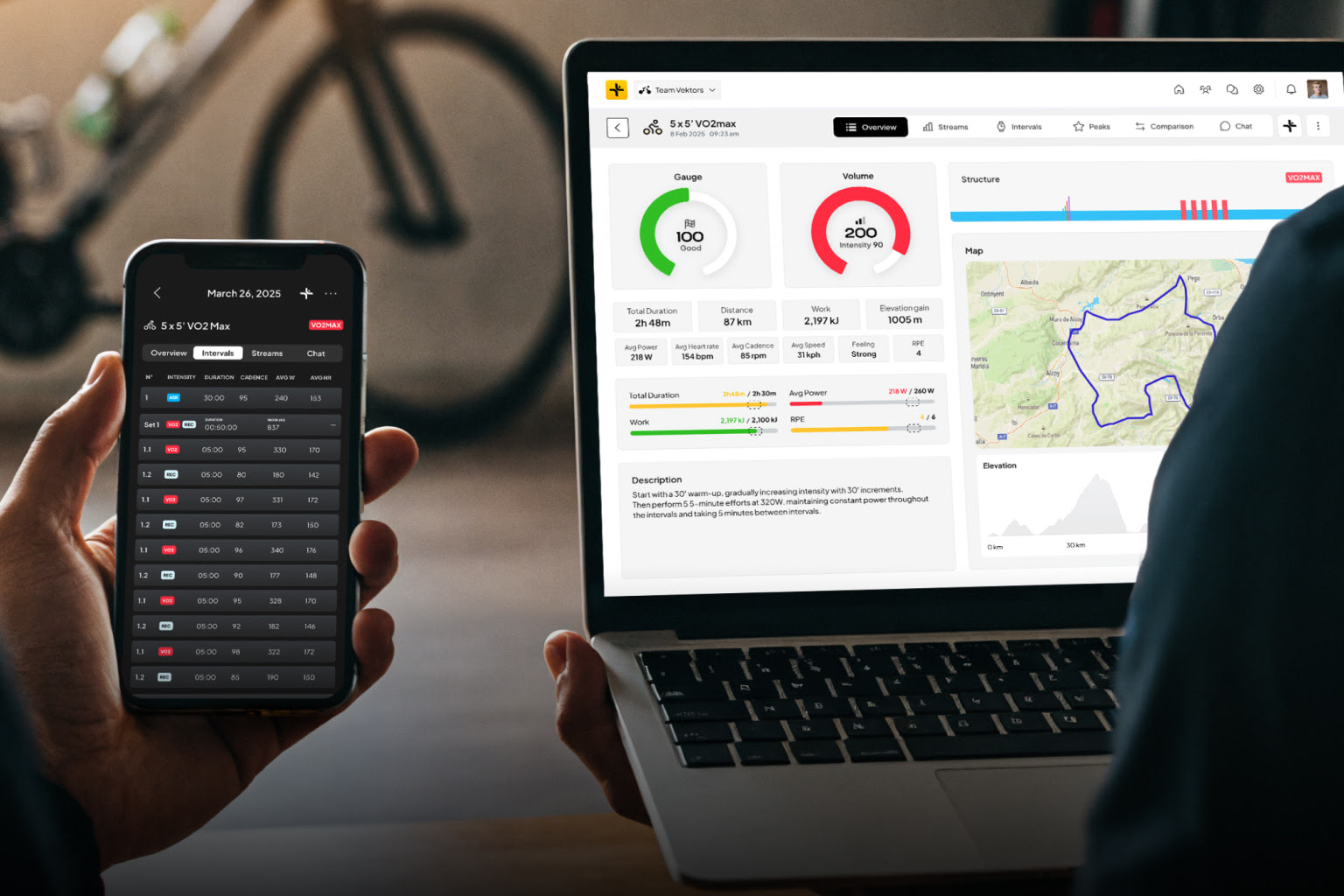
After the test, I want to see the complete files.
Important variables include:
Power → duration → cadence → heart rate → pacing → W′ → CP
I also want to know how the efforts felt.
For example, two tests could produce the same CP but very different physiological responses.
The combination of objective data and subjective feedback gives us much more information than a single number.
10. Don’t test too frequently
Testing itself creates a significant training stimulus.
Repeated maximal efforts have a cost, particularly when using protocols involving several maximal efforts.
The purpose of testing is therefore not to constantly chase a new number.
The purpose is to measure adaptation.
If training is working, we should eventually see changes in the power-duration relationship.
That could mean:
- Higher CP
- Increased power at longer durations
- Increased W′
- Improved durability
- Reduced physiological cost at a given power
- Improved ability to repeat high-intensity efforts
The interesting question isn’t simply:
“Did my CP increase?”
It’s:
“How has my entire performance profile changed?”
The most important principle
A CP test is a measurement tool.
To make it useful, we need to control as many variables as possible and ensure that the efforts genuinely represent your maximal capacity for those durations.
Good testing = good data.
And good data allows us to make better training decisions.
Matteo Cigala
Founder & Head Coach